Categories
Building Community Features Games Microsoft Social Media Xbox

How to bring people back to your site in droves

So, you’ve built your totally kick ass web 2.0, long tail, peer to peer, social networking, beta meme review wiki that has all the paradigm shifting, AJAX created reflections you can shake a stick at.

You’ve been on TechCrunch, Engadget, Boing Boing and you’ve been properly Dugg. You’ve gotten great press and lots of people have tried your site. Trouble is, people come to your site once and return only periodically, but they never add anything to your site. The trouble is, your site isn’t fun.

Make your site fun

I heard a talk that Amy Jo Kim gave back at Etech that really stuck with me. fun.gifShe talked about using gaming mechanics to make your site more fun. Gaming mechanics are essentially elements of games that make them addictive by employing elements of behavioral psychology. A great book on this is Theory of Fun by Raph Koster. According to Raph, “fun is about our brain feeling good.”

I thought about the sites I’ve liked, used and help design and the best, most successful ones all use gaming mechanics to bring people in and keep them there. Community based sites tend to use this best.
I’ll give you the basic outline of some gaming mechanics and then draw a few examples from a number of sites.

Gaming Mechanics

Amy Jo outlines 4 very powerful techniques to bring people back in droves. Most of these items aren’t intended for blogs, but for community based web sites.

  1. Collecting
  2. Earning points
  3. Levels
  4. Scheduled Reward

Each one is a powerful mechanism, but used in combination, they add up to a pretty addictive experience for some. For today, I’ll talk about collecting.

Collecting

Collecting is essentially amassing stuff and showing it off. You know people that are very susceptible to this. Your crazy aunt’s beanie baby collection or your friend who bought all those Magic cards back in college are great “real world” examples of this behavior. Collecting is directly related to the primal instinct to hunt and gather. Primitive men and women who were good at hunting and gathering got better mates. Web sites use this mechanism very successfully (although this is often counter to attracting better mates).

Xbox Live
Ok, I realize that Xbox Live isn’t just a website but it serves as a great example.

When Microsoft launched Xbox Live, they did it to reinforce certain activities they wanted gamers to engage in. The folks at Microsoft want you to a. buy an Xbox and b. buy games. One way to get users to do this is to make the games fun (naturally), but building in some extra elements of fun can’t hurt reinforcing this.

On the Xbox Live site, you can show off your gamer card that shows all the games you’ve played and the “achievements” you’ve collected in a given game. You can then compare how well you’ve done against your friends.

xbox-live-achievements.jpg
Comparing accomplishments and competing against friends is pretty powerful and it makes you want to do better than your friends to show off. Finishing a game, having a higher score, accomplishing something difficult both increases your score (which gets into Points) and the number of accomplishments

Naturally, adding lots of friends to your Xbox profile is powerful as well, but it’s even more powerful on LinkedIn.
linkedin-completedness.jpg

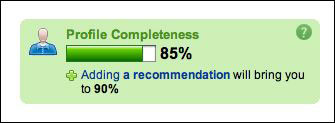
Must. Complete. Profile.

There are a number of activities on LinkedIn that are natural. First, adding your immediate friends and colleagues is probably the reason that you are there, so that’s a no brainer. But adding a recommendation isn’t necessarily a natural thing, but yet you feel compelled to do so in order to have a complete profile. It’s also something that strengthens LinkedIn’s network. That ties into the end point of collecting and that is completing a set.

When talking about collectible card games, beanie babies, Xbox live profiles, or whatever, completing a set is what you are striving for. No one wants an incomplete set and marketers are keen to exploit this angle.

What do your users collect? What sets do your users need to complete?

More later.

Categories
Features iPod iTunes Podcasts

Fill your iPod, fill your head

indexclickwheel20050907.gifHere’s a little weekend fun for you and your iPod.

I’ve found that my iPod usage is a little unusual. First, my music collection is somewhere in the 130 gb range (most of it legal) and that while I do listen to music on my iPod, I listen to podcasts and watch video podcasts more often.

While there is a tremendous amount of crap out there, I’ve found some real gems that introduce me to new topics, challenge my way of thinking or just feel smart.

Here are my top 5 brainy podcasts both audio and video. All links are into the iTunes Music Store.

  1. TEDTalks
    I’ve talked about TEDTalks here before and this video series rarely disappoints. With Al Gore, Julia Sweeney, Jimmy Wales, Nicholas Negroponte and a host of others, the talks given are rarely boring and always thought provoking.
  2. NY Times Talks
    Interviews with Larry David, William Gibson, Bill Murray and talks with Randy Cohen (The Ethicist) are highlights of this podcast series.
  3. Distributing the Future
    This O’Reilly series spotlights the best talks from their conferences featuring leaders from the tech industry. This series is consistently interesting and educational.
  4. NPR Story of the Day
    Story of the Day runs the gamut of NPR’s daily stories and generally delivers a very interesting story that you won’t hear anywhere else.
  5. The Show with ZeFrank
    “He thinks so you don’t have to.” ZeFrank is one part the Daily Show on speed mixed with a teenager’s diary. Tight editing and thought provoking topics (and often just plain ridiculous). If ZeFrank is the future of video podcasting, we’re in for a great future.

Enjoy your weekend, sports racers.

Categories
Building Community Facebook Features Social Media

Facebook faces community wrath

facebook.jpg

Congrats for the milestone, Facebook. I think that it happens to all communities when they get big enough. In every online community, there are people who complain. In some cases, like Slashdot, they do it all the time. Running a community website is hard. Sure, users are basically creating all the content for you, but there are countless tough business and product decisions that need to be made to change and improve sites and people in general, hate change.

Yesterday, Facebook rolled out two new features that they seemed to be quite happy with. Here’s a description of the new features from the PM, Ruchi Sangvhi.

News Feed highlights what’s happening in your social circles on Facebook. It updates a personalized list of news stories throughout the day, so you’ll know when Mark adds Britney Spears to his Favorites or when your crush is single again.

and

Mini-Feed is similar, except that it centers around one person. Each person’s Mini-Feed shows what has changed recently in their profile and what content (notes, photos, etc.) they’ve added.

Now the problem is that many Facebook users like the privacy that they have on the site and weren’t too pleased to see these new features.

Here’s a quote from the Stop It Facebook manifesto on Middlesell.com

When we join facebook, we automatically give up a little bit of our privacy. To use Facebook has always been “socially-acceptable stalking.” Now, though, they’ve just gone too damned far. No one wants their girlfriend or boyfriend knowing when they’ve commented on a photo, written on a wall, or anything else. No one wants people to see that they’ve left a group; it could offend someone. No one really wants to see the change in status of someone’s love life.

And as a result of the member’s revolt, here is a bit of Facebook’s reaction from the CEO.

We’ve been getting a lot of feedback about Mini-Feed and News Feed. We think they are great products, but we know that many of you are not immediate fans, and have found them overwhelming and cluttered. Other people are concerned that non-friends can see too much about them. We are listening to all your suggestions about how to improve the product; it’s brand new and still evolving.

Oh boy. There are whole slew of community lessons here.

First, don’t launch new features until you have the “leadership” of the community sign off on it. I don’t know a lot about Facebook, but as with all community sites, there are people who are their biggest users and usually that means they are your biggest fans.

These people should get previews of new features and other privileges. You need to treat these people like royalty because they are your front line both when you need to deliver a bitter pill and when you are delivering great news. Better yet, they should serve as a both a sounding board and a microcosm for the larger community.

Second, community websites aren’t a lot without any members. If all or a significant part of the user base takes their ball and goes home, it would be devastating for Facebook. Pete Cashmore over at Mashable said it best, “The revolt also underlines that with social networks, the users are in control.”

What Facebook does in the next few days is crucial to their survival. People will always remember this incident on the site and it will affect their perception going forward. 10-20k users out of 9 million protesting is not insubstantial number, especially for the amount of noise they are making. Fortunately, Facebook did react immediately with comments. Now they need to respond with action.

What should the do next?
If it were me, I’d roll the feature back. Issue a mea culpa. Go back to the drawing board. Listen to the users. Design the feature around their needs. At the very least, make the feature opt-in only. That would likely castrate the product, but I’d take this as a very valuable lesson and warning.

Links

Facebook Users Revolt, Facebook replies
Facebook backlash begins

Protesters

A day without FaceBook
TalkFace Message Board
Doug Jones Sneezed, 1:23pm

Categories
Features Jobs Marketing

Job Interviews

interview.jpg

I’m a terrible interviewee. I get nervous. My palms sweat. My throat dries. My mind blanks. When I’m in an interview, I rarely show the dynamic, confident, fun, creative person that I am.

Seth Godin talks today about how bad the interview process is and how the best way to bring someone on is to actually work with them. I couldn’t agree more. Before I started at Epinions, I was given a “homework” assignment to come up with a few ideas to increase usage on the site. I returned with a laundry list of ideas and how to implement them. I also tend to shine when talking about ideas and how to implement them, so that didn’t hurt. Ultimately, it got me the job.

Forever ago, when I started at Yahoo!, every applicant to the surfing department had to take a surfing test. In general, the test took about 3+ hours and covered the gamut topic-wise. I know, a web surfing test sounds ridiculous, but not everyone is cut out to surf the web for a living. Thinking in categorical hierarchies isn’t for everyone, and this test successfully weeded most of those folks out. It’s not that difficult to see how a half day work sample will help you determine a candidate’s worthiness.

I’ve been to thousands of job interviews (thankfully as an interviewer mostly) and I have come to the conclusion that the entire effort is a waste of time. At least half the interview finds the interviewer giving an unplanned and not very good overview of what the applicant should expect from this job…
The other half is dedicated to figuring out whether the applicant is good at job interviews or not.

Tara Hunt adds to the conversation by talking about how interviews tend to weed out anyone who might rock the boat.

I’m just guessing, but I think most unruly people are not good interviewees and get most of their jobs the way I’ve gotten most of mine: through their references…their actual work…the way they prove themselves by doing and not just saying.

Amen, sister!

Categories
Ask Stewtopia Building Community Features Marketing Social Media

Small Business and Social Media

getlocal.jpgA very good friend of mine is relaunching her seasonal store in San Francisco this fall. It’s a really great non-profit business that sells items made by local artists. I talked to her the other day and was trying to convince her that even though the store is local, she should try to use some free online tools out there to help publicize her business online.

Some of these items are specific to the store I’m helping, but others are applicable to any local store. I’ve listed my recommendations in priority order and I can help you with most of the below if you like.

Cheap and Easy

Blog
Your current website is great, but I bet it is hard to update and may not get updated as often as you’d like. Setting up a blog is relatively simple to do and with your down time through the week, you could use your spare time to write about items in the store. Also, write a little profile for the artists/crafters that you feature (or better yet, ask the artists to do this for you). A blog is a great way to both show off what you are selling in-store, but also a way to attract other artist’s to sell their work as well.

Your blog also serves as a good place for people to ask you questions, for reporters to gather info about your store and best of all, other folks to link to you. Blogs tend to get more Google love, so hopefully, it brings you more customers.

Local search
Make sure that your store has a listing in all the local search engines like Yelp, Yahoo, Google, CitySearch, and Judy’s Book. Asking customers to review your store on these sites post purchase probably wouldn’t hurt. Search engines are devoting a lot of effort into these areas and you can only assume that they (at least the bigger ones) are getting a lot of traffic.

Flickr
Photograph everything that comes into the store and post lower resolution images (ie not printable) of the items that are for sale. I know there may be some sensitivity surrounding artist’s work, so make sure they know (and are ok with) you posting pix online. Tag all the images that you upload with your store name and thoroughly tag what they are and who they came from. This will help folks find either the artist or the work in the future.

Also, use Flickr to post pictures from the launch party, (which is something you would probably do anyway). Encourage other photographers to tag their Flickr images with your store’s name. This will help create a larger pool of pictures.

A little sidebar – a good way to make your products look good is to use a lightbox when photographing them. Here’s a link to make a cheap one.

MySpace
Create a MySpace profile for your store. Add all of the artists that you work with as your friends. Join groups and post on forums that make sense for your business. I know that many of your artists have a presence on MySpace and promoting your store and artists in MySpace will get those crazy teens in your store. Seriously, tho, MySpace has helped many a business get going moving product and it’s not outside the norms of MySpace, nor is it against their TOS. And hey, no web design chops necessary ;-).

A little more work and expense

Etsy
Etsy is a great online marketplace for handmade goods online. Create a store to help sell and promote your artists stuff online. I know that the focus of your store is selling local stuff locally, but ultimately, you are the artists agent, and I’m not sure they really care where it is sold, so long as they are putting food on the table. Etsy just did a great promotion with the upcoming Craft magazine from O’Reilly (another great resource to check out).

Second Life
Build a virtual store on Second Life. Ok, this one is a bit more difficult and might take an actual programmer, but a lot of your locals spend time on Second Life and people are spending real money on Second Life. If any of your artists are virtual, perhaps you could get them to sell their virtual goods in your virtual store. The options are virtually limitless. This is one you’d have to find someone else to help (I know a guy).

In the interest of full disclosure, one thing I would recommend is that you should make sure that artists that sell through your store should know what you are planning on doing with their work. You can decide whether to let them opt out of the program, but ultimately, these recommendations can be great ways to promote both your store and the artists.

Ok, that’s my top level view. Any questions?

Categories
Building Community Epinions Features Social Media

Reputation Systems and Gaming Epinions

I want to look a little more at the Yahoo! Answers story and add what I’ve learned about gaming a system. When you look back at the history of Epinions, the site made a big bang when it debuted because it offered to pay writers for their product reviews. The idea was the company would make money off of ads (this is when banners were big) and they would share that money with the community of writers.

At the time, your “Income Share,” as it is known, was based on the number of people that looked at your review. At the time, I believe that the going rate was something in the $.30 per-page-view range. You can just imagine how this got gamed.

How it works
Now, given that the site’s raison d’être was product reviews, there is a relatively finite amount of products to review and ideally, from a shopper’s perspective, you would want the “best” review at the top. So to accomplish this, Epinions built a reputation system called the Web of Trust. In theory, Epinions’ “Web of Trust,” or WoT what an early social network where your “friends” were people whose reviews you trusted and respected.

The second component of review ranking was how helpful someone found your review. At the bottom of every review, users are asked to rate the review on a 4 point scale from “Not Helpful” to “Very Helpful.” Review order is determined by a combination of the two criteria, WoT and review ranking. The basic idea is that if you are trusted more than another member and your review received a higher rating, that review would appear higher up in the list.

The story goes that writers on the site formed rating and trust circles to boost their own reviews over others. The stakes for this were high. If you were the top review on a popular product, most shoppers would see your review first. If you collected all the page views, you received considerably more money than anyone else who wrote the review. And while points are nice, money is a lot better.

So, what did Epinions do to thwart gaming?

Categories
Features Microsoft

Some good Microsoft experiences

And they weren’t even Xbox 360 or Live related.

Maybe my move to Seattle has mellowed me. Maybe I’ve grown up a little and realized that “hating” takes too much energy. I dunno, maybe it’s just the little things that impress me.

This weekend I had two Microsoft experiences that were really nice. Every good story starts with something bad happening and that bad thing for me was trying to load Windows XP Media Center Edition onto my MacBook. I’d bought Parallels so that I could effectively have two laptops in one. The Windows laptop would function as a test bed for new software and website rendering and the Mac laptop would do everything else.

On top of that, I’ve really wanted to play with MCE because I love 10 ft interfaces (ok, it’s a laptop, but work with me here) and the HCI aspects of working with computers in different ways. Unfortunately, Parallels mentions nowhere in its docs that it supports MCE, but I figure, what the heck, it’s really just a 10ft interface tacked onto XP, right?

Categories
Building Community Epinions Features Social Media

Epinions Lesson #1: Let them talk to each other

One of the things that stunned me when I joined Epinions was that they had no formal message boards. Before I joined, (in my mind) the very definition of a Web community was message boards. I had spent countless hours either lurking or actively participating in many message board, Usenet, and BBS communities even before the Web existed. It was weird that Epinions didn’t have message boards. This was community, right? How did they talk to each other?

I discovered, however, that members did talk to one another. Quite a bit actually. First, there were off-site message boards (we’ll save those for another post), but second, while I hadn’t noticed it, every review on Epinions has a comments section. The comments section is where all the community interaction happened on Epinions prior to the launch of Epinions’ message boards.

So what could you expect in the comments section? This is what Epinions wanted to happen in comments:

And here is what happened as well:

In many cases, comments were just a way for friends on the site to let each other know that they read the review and what they thought of it. This is where the flame wars happen. This is where people let you know that they like you. And just like the blogosphere, that’s where community happens on Epinions.

Lesson learned – give people a place to talk, or they will do it wherever they can.

[By the way, we launched message boards on Epinions while I was there. A hell of a lot of community happens there as well 🙂 ]

Categories
Features

@ Wordcamp

Would love to meet you if you are here. Come up and say hi.

randy_file_photo.jpg

Categories
Ask Stewtopia Features

How to make a business card in 3 days (Part 1)

businesscardcomposer.jpgA couple of weeks back, I attended the Gnomedex conference to hobnob with the digital l33t and make some techie contacts in the Seattle area. I registered late for the conference and was not completely prepared to go.

I had no business cards.

The cardinal rule of attending a conference (and making people remember you) is to bring lots of business cards. As I’ve been playing stay-at-home dad for the last few months, my company (ok, my 2 year old daughter) hadn’t yet supplied me with business cards.

I’ve never designed or had business cards made, the companies I’ve worked for have always done it for me. Being a fairly DIY kind of geek, I set out to make them myself. I had several criteria:

  1. They had to look professional.
  2. They had to grab attention.
  3. I had to have them in less than 4 days.

Today I’ll talk about the design part of the process and tomorrow I’ll finish with how and where I got them printed.

More after the link.