Categories
Google Yahoo

The state of online advertising?

yahoovgoogle.jpgIf you think of Google (GOOG) and Yahoo! (YHOO) as bellwethers for online advertising, you have to be scratching your head today. Or maybe not. I think Yahoo! may be the canary in the coal mine.

Google

Ad Slowdown, What Slowdown? – GigaOm
Google revenues surge on ad strength – Financial Times
Google’s 3Q Profit Nearly Doubles – AP
Google revenues surge on ad – MSNBC

and from a few days ago

Yahoo

Dear Google Bulls: Yahoo! Comments still suggests a problem – Henry Blodgett
Dot com bubble 2.0 – Slashdot.org
Yahoo shares fall on 3Q profit decline – AP

So, we’ve got Om Malik in one corner (who just started his own venture backed, advertising funded blog network) saying online advertising is strong versus Henry Blodget (Web 1.0 cheerleader who helped inflate so many dot coms) who thinks that we might be heading into familiar territory.

So who do you believe? If there is one thing that I have learned from being in business on the net for the last 11 years, diversify your revenue streams. Ad sales is a cyclical business which means you have good years and you have bad ones. Ask CNET or Yahoo! who limped through the downturn in 2001-2004. Ask eBay, who didn’t have any problems during the bust, but who is currently buying its way into growing businesses.

God, I hate to say it, but I think I agree with Blodget…
Categories
Links

Links for Thursday, October 19, 2006

Om on Steam
Mr. Malik today talks about the baby steps that the gaming industry is taking into digital distribution. Steam is the digital distribution arm of Valve Software, makers of the popular Half Life series, and recently they have started distributing other game makers’ games.

Games, while heavily pirated online, would benefit greatly from pure digital distribution as Xbox Live seems to be proving. Valve seems to operate a somewhat “locked box” model like the closed system of the Xbox 360 and presumably the PS3.

Midsummer Night’s Virtual World
Interview with the Indiana University professor, Edward Castranova, who won a grant to create, “Arden: The World of Shakespeare,” online game. The idea behind the game is to create a virtual petri dish to study virtual worlds. Castranova wrote the book Synthetic Worlds last year and is the head of IU’s Synthetic Worlds Initiative. This doesn’t sound like the next WoW, but the study should be interesting.

Turning Social Networks into Dollars
CNET talks today about how social networks are devising ways to make money from their users through targeted advertising.

Mac LightScribe Software
So, unfortunately, if you already own one of these drives, it doesn’t look like this will help, but LaCie has created the first software to create LightScribe discs on the Mac. LightScribe, is a technology for CD burners that can burn an image on the top of discs that you burn. Pretty cool stuff and finally available for the Mac.

Categories
Downloads Links Video YouTube

Links for Tuesday, October 17, 2006

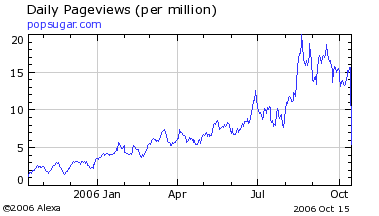
PopSugar gets $5mm in funding from Sequoia
Blog network for “young, hip women” got a nice kitty from the folks at Sequoia. It looks like PopSugar’s main site has been growing a fair clip on their main blog (see graphic) and are doing a bit more than just blogging with a little bit of social networking thrown in. With women marrying and having kids later in life, this is a strong demographic that is under-served on the net.
graph-2.png

UndoTV launches…kinda

Looks like Chris Pirillo and Leo Laporte are getting the band back together for one more show…or an online revival of the TechTV gang of old. The site also looks to be a hub for getting other folks involved uploading their own reviews and tech related content. Looks interesting, although, this could just be a channel on YouTube, so I’ll be curious to see how they differentiate the product.

Categories
Apple General

Nerd-tastic!

A bit of digression-

Here are pix from a couple of events that I’ve gone to recently.

Woz

woz.and.scoble.jpg

First, a couple of Friday’s ago, Steve Wozniak was interviewed on the UW campus by Robert Scoble (I say interviewed, but Scoble didn’t get a lot in edge wise). Woz is someone that I have always respected a lot because it has always seemed that he was a highly unlikely revolutionary. Money and fame hasn’t changed him as he seems to be as lovable a nerd as ever. Great stories from the man who brought computers to the rest of us.

Woz Trivia – apparently, Woz was once the highest scoring player of Gameboy Tetris so many times in Nintendo Power magazine that they asked him to stop submitting his scores.

Hopefully, Scoble puts his video up soon so you can watch this highly animated talk.

John Hodgman

hodgman.jpg

Second, John Hodgman visited Seattle’s Elliott Bay Book Company to promote his book, Areas of My Expertise, going into paperback. Readers may be familiar with his Daily Show work or maybe his Apple ads as the lovable dufus, the PC. If you get a chance to see John on his book tour, I highly recommend it. His reading and routine are quite witty and his book is side-splittingly funny.

John is pictured with my friend, Suzi.

Categories
Building Community Links Social Media

Links for Monday, October 16, 2006

Tailrank 2.0
New features detailed in the Tailrank blog, but here are the highlights: archives added, Entertainment category added, and the ability to expand and contract whole stories. Great upgrade for an invaluable service.

CNET and Reuters in Second Life
More services for the quickly growing virtual world. 900k members? Didn’t they just have 300k back in June? Wow.

Joining the Party, Eager to Make Friends
NYTimes reports on social media marketing by big brands.
[via Tailrank]

Taxing virtual worlds
So, do you think the IRS will set up a bureau in Second Life? [via Slashdot.org]

Categories
Apple iPod

Jobs’ saucy Newsweek interview

steve's-business.jpgApparently, sex sells iPods, at least according to Steve Jobs quotes in this week’s Newsweek.

In celebration of the iPod’s fifth anniversary, Steven Levy sat down with Steve Jobs to talk about the appeal of the iPod and a bit about where the iPod is going. Two quotes really stuck out at me as being a bit off message for Steve, but maybe a signal of some new marketing coming down the pike.

First, when asked about the iPod’s cool factor waning due to overexposure, Jobs’ replied, “That’s like saying you don’t want to kiss your lover’s lips because everyone has lips.”

Um, ok.

Then towards the end of the interview when asked about sharing songs on the Zune, he comments:

It takes forever. By the time you’ve gone through all that, the girl’s got up and left! You’re much better off to take one of your earbuds out and put it in her ear. Then you’re connected with about two feet of headphone cable.

I suddenly understand why the iPod is so popular. It helps you get chicks.

Read

Categories
Consumer Electronics Sony

Sony Reader review roundup

sony-reader.jpgReviews in the New York Times and the Wall Street Journal today confirm that the Sony Reader isn’t quite ready yet. Pogue liked it more than Mossberg, but both had reservations.

I saw the Reader back at CES this year and despite my own skepticism, really liked it. The screen was incredible, highly legible and much easier on the eyes than LCD. The technology the Reader is based on, e-ink, has been around for a few years, but there have been no consumer applications until now.

If you’re inclined, here’s a bit from the Times explaining how e-ink works:

Sandwiched between layers of plastic film are millions of transparent, nearly microscopic liquid-filled spheres. White and black particles float inside them, as though inside the world’s tiniest snow globes. Depending on how the electrical charge is applied to the plastic film, either the black or white particles rise to the top of the little spheres, forming crisp patterns of black and white.

In any case, the screen looked great and the device had a lot of promise. Sadly, many of the features (which aren’t core ebook features to most) are either poorly implemented or require Sony’s PC only software. The device, besides reading books from Sony’s store, will also read RSS feeds, pdf and Word files.

And unfortunately, there is the rub. The Reader will only read RSS feeds that Sony has pre-selected and the Reader will only update those feeds once a day.

Pdf files must be re-formated for the Reader to render them properly. From Walt Mossberg’s review:

But the Reader’s claim to display PDF documents proved hollow. In every PDF document I tried, the text was nearly unreadable and the text resizing feature of the Reader didn’t help. Sony concedes that PDF documents work well on the Reader only if they are created for the Reader’s screen size and resolution. But it includes no conversion software to make them fit.

Maybe I’m being too nit-picky. The Reader will fit exactly one of my needs – I read a lot of books, but I never know what I’ll be in the mood to read. The Reader will reduce a stack of books to the size of a paperback and works almost as well as the paper it replaces.

I think I’m still waiting until version 2.

Categories
Building Community

Links for Monday, October 9, 2006

Participation Inequality
Jacob Nielsen talks about how to increase participation on your site.

Different Online Social Networks Draw Different Age Groups
Showing off its incredible command of the obvious, IHT reports Saturday on a study from ComScore that MySpace and Friendster appeal to different age groups. In earlier news, ComScore also reports that the sun will go down tonight.

Categories
Google Social Media Video Yahoo YouTube

For Mark Cuban, history repeats itself

gootube.jpg

The first thing that I thought today was how strange it was that Mark Cuban had been calling Google “moronic” for thinking of buying YouTube. I don’t imagine that he was telling Tim Koogle that he was “crazy,” for buying his company, Broadcast.com, a company that Yahoo! would spend the next several years dismantling.

Mark’s definitely asking the right question as to whether this is a good deal for YouTube or not. After all, Broadcast.com, which arguably was more of a “real business,” (they had corporate customers, after all), wasn’t making any money and still got $5 billion. YouTube probably should have held out for a lot more money.

Ah, but those were bubble times and everyone thought that the future would come more quickly than it did. Who could have imagined that streaming video would suck so much? Aside – can you pause Real, QT or WMV streaming without waiting for 2+ mins for it to restart yet?

While the YouTube acquisition is similar to Yahoo!’s acquisition of Broadcast.com, I think there are two key differences. First, the iPod (and to a certain degree, the cell phone). Everyone has one (or both) and short form video excels on these devices. I know you can’t carry these YT videos around easily yet, but it’s coming.

Second, and more importantly, is the Class of 2009. If you live anywhere near teenagers, you may have noticed that there are a lot of them. The Class of 2009 (and the years surrounding them) is the largest graduating class in American history. These kids are already powering a lot of Web 2.0. They have always had a computer in their home and they probably can barely remember not being connected to the internet.

Google’s acquisition of YouTube is part of their bet on this upcoming generation of creators. It has taken us a long time, but we’re finally getting people off their butts and making them into content producers not just consumers. Mark Cuban helped lay the groundwork for this revolution and instead of pedantically nitpicking from the side lines, he should be cheering them on.

Now, let’s just hope they find a business model. 🙂

Categories
Features Social Media

Looking back to look forward

sm1_03A.gif

I remember first picking up Wired Magazine because its heavy stock cover and non-standard size. Most magazines at the time were all basically the same size and shape and generally of varying paper weight from light to completely flimsy. I’ve always been a bit of magazine nerd and also being a computer nerd made Wired an easy purchase for me.

Mitch Kapor

Wired was a big influencer of mine (especially in college, don’t get me started on their decline), but one article in particular has stuck with me for a long time. In Wired 1.03, published in July of 1993, Mitch Kapor wrote a manifesto called “Where Is the Digital Highway Really Heading?” that inspired me at the time and it was that article that really began my fascination with the internet and what the future might hold. Unlike re-reading most futurist prognostications, looking back at that article today doesn’t make for a good laugh. Most of what Mitch talked about then has come to pass.

Now a lot of the article talks about the technical and political hurdles of our current reality, but I’m more interested in the social implications of the article. The idea that captivated me most was that in the internet was “an interactive medium based on two-way communications, where people can fluidly shift from position of listener to that of speaker, from role of consumer to that of provider.”

Hmmm….. this sounds familiar.

So, Mitch Kapor looks like a pretty big smarty-pants, eh? Well, actually, this future, in theory, should have come a long time ago.

The web, you might remember, was given to us by Tim Berners-Lee while he hanging out at CERN in Switzerland. He had originally thought that “editing the web was as important as browsing it.” With the benefit of hind sight, that’s certainly not what happened with Web 1.0.

Social Media

So what the hell is my point? I think that blogs, video sharing, wikis and the rest of social media are fulfilling that prediction of everyone becoming both a consumer and a provider. How long will it take us to get there? It took about 7 years for the first generation web to boom and bust, but even with the bust, people’s behavior had changed permanently. I’m too chicken-shit to make a bad prediction on my blog, but it looks like we’ll get there before you know it.

Thanks Mitch for inspiring so many.

Read the original article here.